
Introduction & PAC Pattern

What is WakaPAC?

WakaPAC is a reactive UI library in a single JavaScript file that provides data binding, component coordination, and automatic DOM updates.

About the name

The name WakaPAC combines Waka (inspired by Pac-Man) with PAC, the Presentation-Abstraction-Control architecture pattern it implements.
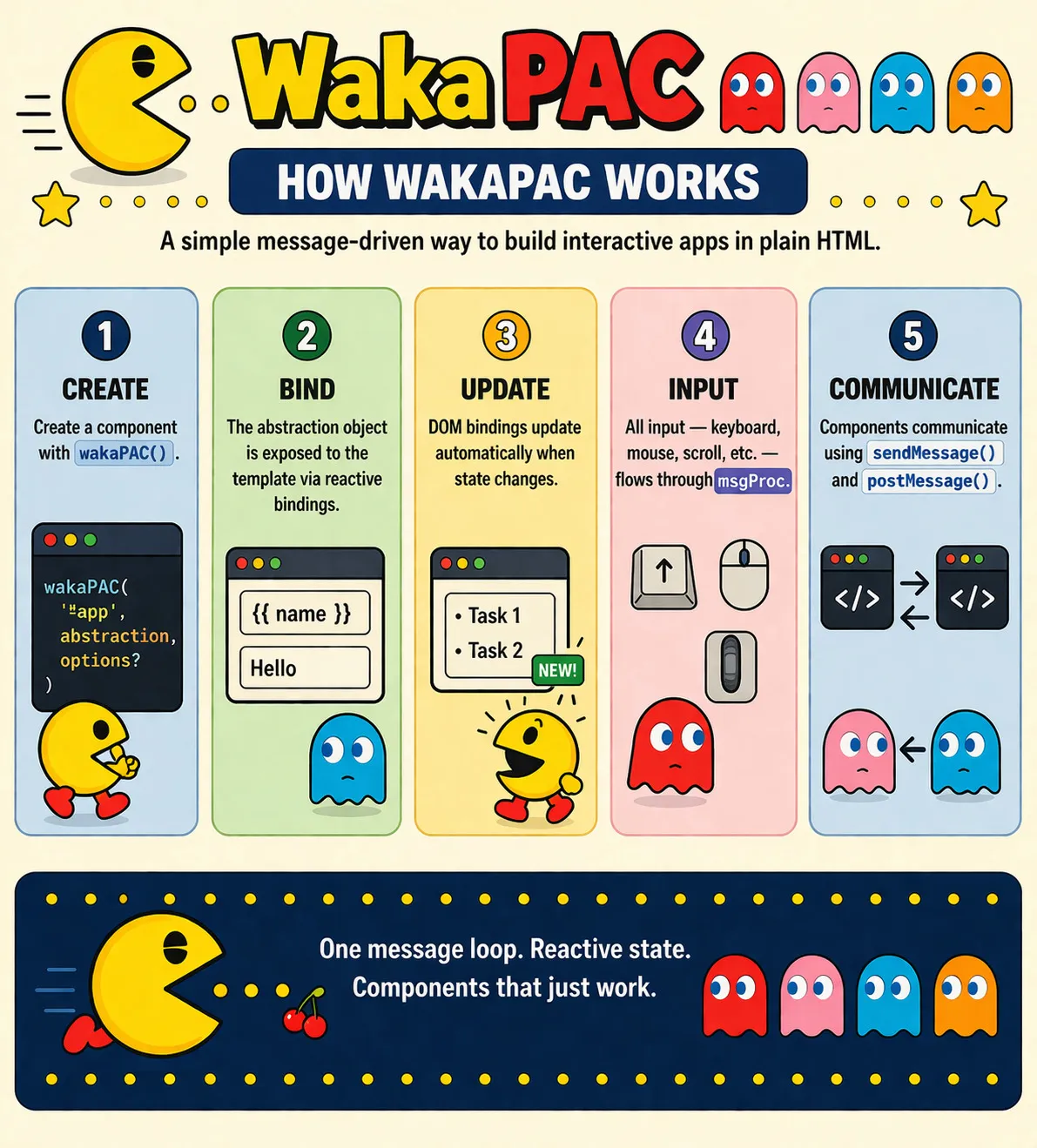
Quick Example

Here's a complete interactive application:

<!DOCTYPE html>
<html>
<head>
    <script src="https://cdn.jsdelivr.net/gh/quellabs/wakapac@main/wakapac.min.js"></script>
</head>
<body>
    <div id="app">
        <h1>Hello {{ name }}!</h1>
        <input data-pac-bind="value: name" placeholder="Enter your name">
        <p>Character count: {{ name.length }}</p>
    </div>

    <script>
        wakaPAC('#app', {
            name: 'World'
        });
    </script>
</body>
</html>

That's it. Type in the input and watch the heading and character count update automatically. No compilation, no virtual DOM, no JSX - just reactive HTML.

Key Features

Reactive Data Binding

Two-way synchronization between application state and the DOM. Updating your data automatically updates the UI, and user interaction updates state without manual event wiring.

<input data-pac-bind="value: email">
<p>You entered: {{ email }}</p>

Declarative Templates

Declare UI behavior directly in HTML using bindings and expressions. Templates describe how data maps to the DOM without imperative DOM manipulation.

<button data-pac-bind="click: save, enable: !saving">
    {{ saving ? 'Saving...' : 'Save' }}
</button>

<ul data-pac-bind="foreach: items" data-pac-item="item">
    <li>{{ item.name }}: {{ item.price }}</li>
</ul>

Computed Properties

Define derived values that stay in sync automatically. Computed properties recalculate whenever their dependencies change, without manual bookkeeping.

wakaPAC('#app', {
    firstName: 'John',
    lastName: 'Doe',

    computed: {
        fullName() {
            return `${this.firstName} ${this.lastName}`;
        }
    }
});

Component Hierarchy

Coordinate parent and child components through built-in messaging. Components can exchange events and data without manual wiring or shared global state.

// Parent component
wakaPAC('#parent', {
    receiveFromChild(type, data) {
        console.log('Child sent:', type, data);
    }
});

// Child component - automatically detects parent
wakaPAC('#child', {
    sendUpdate() {
        this.notifyParent('update', { value: 42 });
    }
});

Multiple Element Binding

Instantiate reusable components across multiple DOM elements. Each matched element becomes an independent reactive instance with its own state.

<div class="counter">Count: {{count}} <button data-pac-bind="click: increment">+</button></div>

<script>
    wakaPAC('.counter', { count: 0, increment() { this.count++; } });
</script>

Browser & Container Properties

Access browser and container state as reactive data. Scroll position, visibility, dimensions, and connectivity are exposed as properties that update automatically without manual listeners.

<button data-pac-bind="visible: browserScrollY > 300, click: scrollToTop">
    ↑ Back to Top
</button>

<div data-pac-bind="visible: !browserOnline" class="offline-banner">
    You're offline - changes will sync when reconnected
</div>

Expression Language

Use expressive inline logic directly in templates. Bindings support conditional logic, arithmetic, and common data operations without external helpers. Expressions are evaluated through a dedicated parser for predictable execution.

<p>Total: ${{ total }}</p>
<span>{{ count > 0 ? count + ' items' : 'Empty' }}</span>
<div data-pac-bind="class: { active: isSelected, disabled: !enabled }">

Desktop Subsystem

Handle interaction through a unified message-driven event system. Browser input and system events flow through a single interface for consistent processing.

wakaPAC('#app', {
    msgProc(event) {
        switch (event.message) {
            case wakaPAC.MSG_LBUTTONDOWN:
                // wParam contains modifier flags: MK_SHIFT, MK_CONTROL, etc.
                // lParam contains mouse coordinates
                const x = wakaPAC.LOWORD(event.lParam);
                const y = wakaPAC.HIWORD(event.lParam);
                console.log(`Left click at ${x},${y}`);
                break;

            case wakaPAC.MSG_KEYDOWN:
                // wParam is the virtual key code
                if (event.wParam === wakaPAC.VK_RETURN) {
                    console.log('Enter pressed');
                }

                // Check modifiers in lParam
                if (event.lParam & wakaPAC.KM_CONTROL) {
                    console.log('Ctrl was held');
                }

                break;
        }
    }
});

Complete feature set:

  • Message constants: MSG_LBUTTONDOWN, MSG_KEYDOWN, MSG_MOUSEMOVE, MSG_TIMER, MSG_USER + all Win32 message types
  • Virtual key codes: VK_RETURN, VK_ESCAPE, VK_F1-F12, VK_A-Z + complete Win32 VK_* constants
  • Modifier flags: MK_SHIFT, MK_CONTROL, MK_ALT, KM_SHIFT, KM_CONTROL, KM_ALT
  • Message functions: sendMessage(), postMessage() for inter-component communication
  • Hit testing: ptInElement() equivalent to Win32's PtInRect

What Makes WakaPAC Different?

Developer Task WakaPAC Vue / React / Alpine
Start using in an existing page Single script tag — no build step Vue/React typically use build tooling; Alpine runs directly
Bind form inputs to state Built-in two-way bindings via attributes Vue/Alpine built-in; React requires explicit state handlers
Handle user input and system events Central message pipeline inspired by desktop event models Component-scoped DOM/event handlers
Communicate between components Automatic parent/child messaging without manual wiring Props/events or shared state patterns
Template syntax Mustache + declarative attributes Vue/Alpine templates; React JSX
Mental model Reactive container + message-driven execution Component tree with framework conventions

Understanding the PAC Architecture

WakaPAC is built on the Presentation-Abstraction-Control (PAC) pattern, which cleanly separates three concerns:

1. Presentation (Your HTML)

What the user sees and interacts with - your templates and DOM elements.

2. Abstraction (Your Data)

What your application knows - your data model, computed properties, and methods.

3. Control (WakaPAC)

What keeps them in sync - WakaPAC's reactive layer that handles DOM updates, event routing, and dependency tracking.

The key difference from MVC: In PAC, the Presentation and Abstraction layers never communicate directly - all interaction goes through the Control layer. This means:

  • Automatic reactivity: You never manually update the DOM - change your data and the Control layer updates the presentation
  • Predictable flow: Data changes always flow through the same path, making debugging easier
  • Clean separation: Your HTML templates and JavaScript data models remain completely independent

As a developer, you only work with Presentation (HTML) and Abstraction (JavaScript). The Control layer is WakaPAC itself, working behind the scenes.

When to Use WakaPAC

WakaPAC is ideal for:

  • Rapid prototypes and MVPs that benefit from built-in reactivity without a build pipeline
  • Content-driven sites that include interactive UI elements such as dashboards, admin panels, or forms
  • Progressive enhancement of server-rendered pages with reactive behavior
  • Projects that prioritize simplicity, portability, and low operational overhead
  • Workflows centered on plain HTML and JavaScript with minimal tooling
  • Applications that benefit from a centralized, message-driven interaction model

Consider alternatives if you need:

  • Optimization strategies tailored for very large SPA architectures
  • A large ecosystem of pre-built UI components and plugins
  • Deep TypeScript-first tooling and framework-level type integration
  • Built-in SSR or SSG pipelines tightly coupled to a framework runtime

File Size

WakaPAC is a single JavaScript file with zero dependencies. The entire framework - reactive system, component hierarchy, expression parser, browser properties - is in one file you can drop into any project.

File sizes:

  • Source: ~339KB (with extensive comments)
  • Minified: ~70KB
  • Minified + Gzipped: ~18KB

Comparison (all sizes minified + gzipped):

  • WakaPAC: ~18KB - complete framework in one file
  • Alpine.js: ~15KB - minimal feature set
  • Vue 3: ~33KB - runtime only — excludes optional routing/state libraries
  • React + ReactDOM: ~40KB - runtime only — excludes optional routing/state libraries

Performance

WakaPAC optimizes updates through:

  • Expression caching: Parsed expressions are cached to avoid repeated parsing overhead
  • Value comparison: Expressions are re-evaluated, but DOM updates only happen when values actually change
  • Scoped updates: Only elements in the component's binding map are processed, not the entire DOM tree

This simple approach is efficient because DOM manipulation is the expensive operation - evaluation and comparison are fast.